Why you underestimate your subscription spending
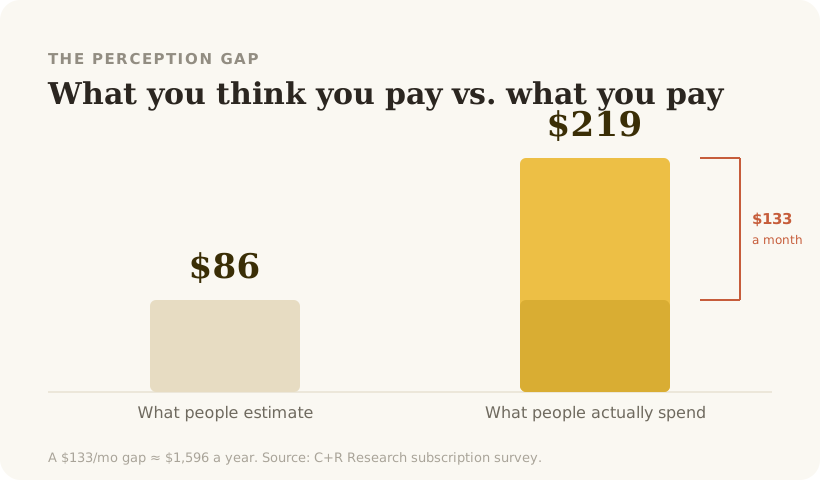
Ask people what they spend on subscriptions and the average answer is about $86 a month. Add up their actual charges and the real figure is closer to $219 (C+R Research). That $133/month gap — roughly $1,596 a year — isn't carelessness. It's a predictable result of how subscriptions are designed.
The gap is built into the model
Nearly nine in ten people underestimate their subscription total, and West Monroe found the miss is often around 2.5x. A handful of design choices reliably produce that error:
- Auto-pay removes the moment of decision. 72% of people have every subscription on auto-pay. A charge that requires no action also requires no attention — so it gets none.
- Small numbers don't feel like money. "$9.99" reads as nothing. Twelve of them is $1,439 a year. Our brains price each charge in isolation, never as a sum.
- Annual billing hides the monthly cost. A once-a-year renewal drops off your radar for eleven months, then lands as a "surprise" you technically agreed to.
- Charges are scattered. Different dates, different cards, some through the App Store, some direct. You never see them lined up, so you never total them.
The forgetting is real, and expensive
This isn't just underestimating — it's genuine forgetting. 42% of people admit they pay for at least one subscription they've completely forgotten about (West Monroe), and somewhere between 48% and 65% have been charged after forgetting to cancel a free trial (C+R Research; RecurStop). Free trials are especially effective: they ask for payment details up front and rely on you not returning at exactly the right moment weeks later.
There's also status-quo bias — the tendency to keep things as they are. Many people hold onto a subscription "just in case," even when they haven't opened it in months. Cancelling requires a small active effort; keeping requires none. The path of least resistance is always: keep paying.
How to close the gap
The cure for a perception gap is simply seeing the real number:
- Do one honest audit. Check App Store and Play Store subscriptions, search your email for receipts and renewal notices, and scan one card statement. List everything with its price.
- Convert everything to an annual figure. Multiply monthly costs by 12; the yearly total is what actually changes behavior.
- Flag anything you can't remember using in the last month. Those are your first cuts.
- Make the invisible visible going forward. The reason the gap reappears is that charges go back to being scattered and silent. A single place that surfaces your true total and warns you before renewals keeps the number honest.
Awareness genuinely changes behavior here — most people who see their real total cut something within the week. The hard part was never the decision. It was never being shown the number in the first place.
Pip reads your email receipts to show everything you pay for, flags overlap and price rises, and warns you before charges hit. No bank needed.
Join the Beta →